Our Approach
Our methodology is grounded in research on learner modeling and adaptive systems. We treat each student profile as a dynamic set of variables – including academic histories, goals, constraints, and progression patterns – rather than a static application.
This allows us to move beyond surface-level evaluation and towards structured, context-aware decision-making.
Core Pillars
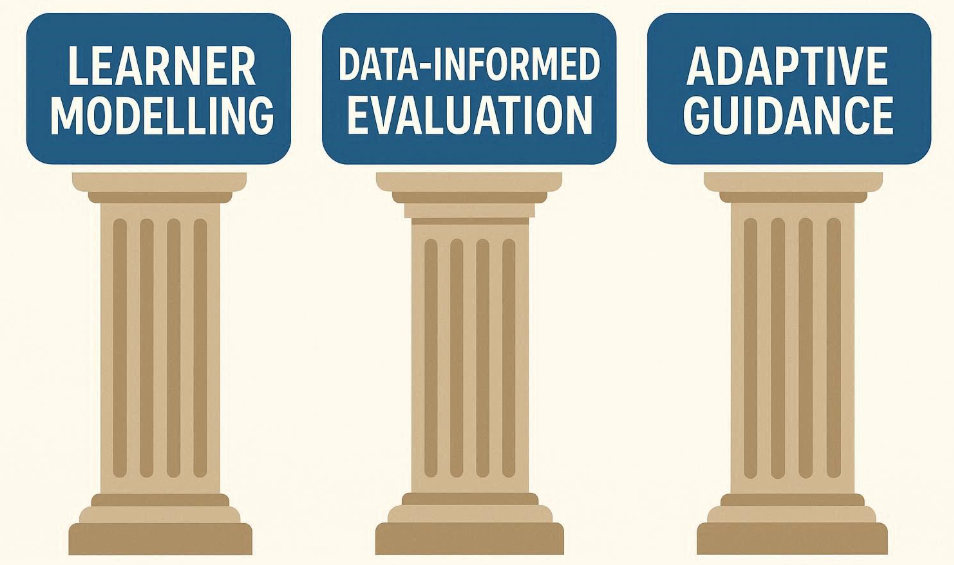
Learner Modelling
Learner profiles are interpreted as evolving systems rather than static snapshots.
This includes:
- academic performance over time
- subject strengths and areas of inconsistency
- progression pattern
- stated goals within their academic context
The aim is to understand learning potential and pathway, not just past results.
Data-Informed Evaluation
Interpretation is guided by structured, evidence-informed criteria rather than informal judgment or opportunistic matching.
This allows for a consistent understanding of:
- alignment with academic and institutional expectations
- readiness conditions across different pathways
- feasibility of progression over time
This approach ensures that insights remain transparent, consistent, and clearly grounded.
Adaptive Guidance
Academic pathways are not fixed -they evolve with the learner.
As new information becomes available—such as performance updates, changing goals, or external constraints—insights are updated to reflect the learner’s current trajectory.
This allows our support to remain:
- relevant to current performance
- responsive to change
- aligned with ongoing progression
Process Snapshot
Each evaluation typically follows three stages:

Organising academic and contextual data into a usable format.
Assessing fit between the student profile and academic pathways
Producing a clear, structured evaluation with next steps.
Our approach is designed to bring clarity and structure to academic decision-making, where uncertainty is often high, and guidance is often inconsistent.