
Securing Graduate Funding
A Comprehensive Guide to Finding and Winning Scholarships, Fellowships, and Research Funding
Introduction
Graduate education is a significant investment of time, effort, and financial resources. Fortunately, many universities, governments, research organisations, charitable foundations, and private institutions offer funding to support talented students pursuing master’s and doctoral degrees. However, obtaining funding is highly competitive and requires careful planning, strategic preparation, and persistence.
This guide outlines practical strategies for identifying funding opportunities, preparing competitive applications, and maximising your chances of securing financial support for graduate studies.
Key Takeaway
Securing graduate funding is rarely the result of a single outstanding achievement. More often, it reflects careful preparation, a strong academic and research profile, thoughtful storytelling, and persistence. By starting early, identifying opportunities that align with your goals, cultivating meaningful mentorship, and tailoring every application, you can significantly improve your chances of earning financial support for graduate study. Remember that every application is an opportunity to refine your skills, clarify your ambitions, and move one step closer to achieving your academic and professional goals.
Understanding Graduate Funding
Graduate funding is financial support that helps cover tuition fees, living expenses, research costs, travel, or a combination of these. Unlike student loans, many funding opportunities do not require repayment, provided recipients meet the conditions of the award.
Common sources of graduate funding include:
- University scholarships
- Government scholarships
- Research assistantships (RAs)
- Teaching assistantships (TAs)
- Research council grants
- International development scholarships
- Professional societies
- Charitable foundations
- Industry-sponsored research
- Employer sponsorships
Understanding the differences between these funding mechanisms helps you target opportunities that best match your academic background and career goals.
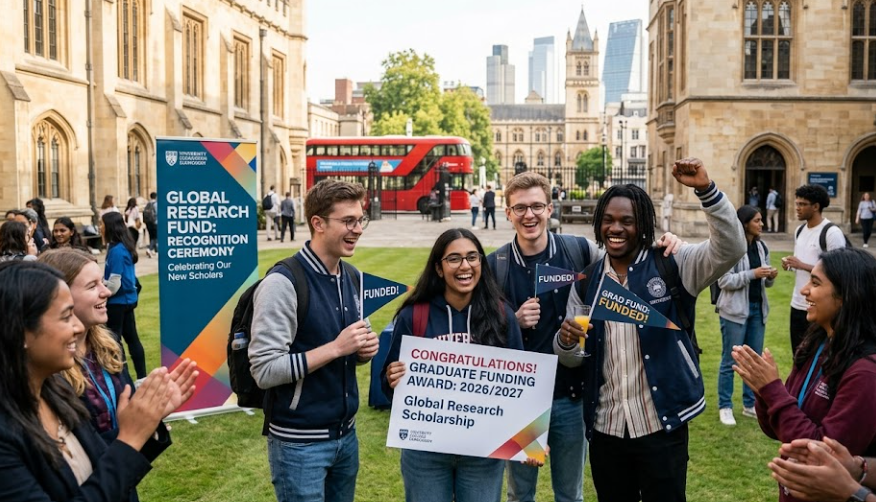
The steps outlined below highlight the key factors that contribute to a successful application.
Start Planning Early
One of the biggest mistakes applicants make is beginning their funding search too late. Many prestigious scholarships have deadlines six to twelve months before the start of the academic programme.
Create a calendar that includes:
- Scholarship deadlines
- Admission deadlines
- Supervisor application deadlines
- Reference letter deadlines
- Language test dates
- Standardised test dates (if required)
- Visa application timelines
Early preparation allows time to strengthen your application rather than rushing to meet deadlines.
Funding That Matches Your Profile
Rather than applying indiscriminately, pay attention to the eligibility requirements and focus on opportunities that align with your academic achievements, research interests, nationality, career goals, and professional experience.
Funding opportunities may target:
- International or Domestic students
- Women in STEM
- Students from low &middle-income countries
- Early-career researchers
- Underrepresented groups
- Specific research disciplines
- Public health or biomedical sciences
- Community impact
Reading eligibility requirements carefully can save considerable time and effort.
Build a Competitive Academic Profile
Funding bodies invest in applicants who demonstrate the potential to contribute meaningfully to research, innovation, and society.
A competitive application often includes:
Strong Academic Performance: Good grades remain an important indicator of academic preparedness. While perfect grades are not always necessary, applicants should demonstrate consistent academic achievement and intellectual ability.
Research Experience: Participation in research projects, laboratory placements, internships, dissertations, or independent research demonstrates readiness for graduate-level study.
If possible, seek opportunities to:
- Present at conferences
- Publish research
- Assist in laboratory projects
- Participate in collaborative research
These experiences strengthen both your CV and your confidence.
Leadership and Service: Many prestigious scholarships evaluate applicants beyond academics.
Examples include:
- Student leadership
- Community engagement
- Volunteer work
- Professional organizations
- Science outreach
- Mentoring activities
These experiences demonstrate initiative, responsibility, and a commitment to making a positive impact.
Develop Relationships with Academic Mentors
Strong recommendation letters are among the most influential components of many funding applications.
Choose referees who:
- Know your work well
- Can comment on your research potential
- Have supervised your academic work
- Can provide detailed examples of your strengths
Provide referees with sufficient notice and share your CV or ORCID ID, research interests, and scholarship information so they can write informed and personalised letters.
Write a Compelling Personal Statement
The personal statement is your opportunity to explain why you are pursuing graduate study and why you deserve funding. An effective statement should clearly explain the following:
- Your academic journey
- Your research interests
- Why the programme is a good fit
- Your long-term career goals
- How the scholarship will help you achieve those goals
- The broader impact of your future work
Prepare a Strong Research Proposal
Many research-based master’s and PhD funding applications require a research proposal. A successful proposal should demonstrate:
- Knowledge of the existing literature
- A clearly defined research problem
- Well-formulated research questions
- Appropriate methodology
- Feasibility
- Potential scientific or societal impact
Funding reviewers are often interested in your ability to think critically and design meaningful research rather than expecting a fully developed project.
Tailor Every Application
One of the most common reasons applications are unsuccessful is that applicants submit generic materials.
Tailor each application by:
- Addressing the scholarship’s objectives
- Highlighting relevant achievements
- Using language that reflects the organization’s mission
- Demonstrating how your goals align with the funder’s priorities
Small adjustments can significantly improve the competitiveness of your application.
Prepare for Scholarship Interviews
Some funding programmes include interviews to assess applicants’ motivation, communication skills, and research potential.
Prepare to discuss:
- Your research interests
- Why you selected the institution
- Your career aspirations
- Current developments in your field
- Leadership experiences
- Challenges you have overcome
- How you would contribute to the university community
Practice answering questions confidently while remaining authentic.
Stay Organised
Managing multiple scholarship applications can quickly become overwhelming. Keep a spreadsheet record of applications bookmarked, in-preparation and those that have been submitted so you can track:
- Application status
- Deadlines
- Required documents
- Reference submissions
- Interview invitations
- Funding decisions
A simple spreadsheet or project management tool can help ensure that no important requirement is overlooked.
Learn from Rejection
Funding decisions are highly competitive, and even outstanding applicants may not receive every scholarship they pursue.
If your application is unsuccessful:
- Request feedback when available.
- Strengthen weaker parts of your application.
- Gain additional research or professional experience.
- Apply again during future funding cycles.
- Continue exploring alternative funding opportunities.
Persistence is often one of the defining characteristics of successful scholarship recipients.
Common Mistakes to Avoid
Avoid these frequent pitfalls:
- Missing application deadlines
- Ignoring eligibility criteria
- Using generic personal statements
- Submitting poorly proofread applications
- Choosing referees who know you only superficially
- Failing to demonstrate alignment with the funding organization’s mission
- Underestimating the importance of research experience and leadership activities
Attention to detail can make the difference between a strong application and one that is quickly overlooked.
Share this