

Teacher-AI Complementarity: Scaling Personalisation
A Teacher’s Guide to Hybrid Intelligence in Education
Introduction
As Artificial Intelligence is increasingly integrated into educational activities, the learning process is becoming more personalised. Adaptive Learning Systems can process large amounts of students’ learning data, identifying patterns in performance and engagement, and recommending activities relevant to individual learners’ needs. However, true personalisation of the learning process goes beyond technical application. Effective teaching-learning requires professional judgment, empathy and emotional intelligence, knowledge of the learners, understanding of context, and social interaction. While AI tools can handle the effective processing of educational data and routine recommendations, teachers retain responsibility for pedagogical strategy, interpersonal relationships, and professional judgment. Rather than viewing Artificial Intelligence as a replacement for educators, a complementary approach assigns different responsibilities to humans and AI.
What is Teacher-AI Complementarity?
Teacher-AI complementarity is an approach in which educators and AI systems contribute different, but connected capabilities to the pedagogical process.
Identifying different areas where each is suitable is important: AI is well suited to tasks involving the processing of large volumes of educational data, identifying patterns in students’ learning trajectory, detecting changes in performance or engagement, recommending resources or learning activities, adjusting the difficulty or sequence of digital tasks, and providing immediate, routine feedback.
Teachers, meanwhile, contribute capabilities that depend heavily on context and human judgment, including: understanding individual students and classroom dynamics, interpreting why a student may be struggling, selecting appropriate teaching strategies, motivating and encouraging learners, adapting explanations to student needs, making decisions about assessment and intervention, supporting students’ social and emotional development.Therefore, the focus is shifting from automating the teaching process to using AI tools to support teachers in what they can do effectively.
From Automation to Partnership
In a complementary approach, the system can provide the teacher with evidence or relevant recommendations, while the teacher decides how that information should be applied to inform instruction.
For example, an adaptive learning platform might detect that a student is repeatedly making errors with a particular mathematical concept. It can process the student’s previous attempts and recommend additional practice. The teacher can then review this information, consider what they know personally about the student’s learning, and decide whether the student needs a targeted exercise, a different explanation, peer collaboration, or personalized support. In this scenario, the AI accelerates the process of identifying patterns. The teacher provides the affective and educational responses needed to encourage the student in their learning.
Scaling Personalization
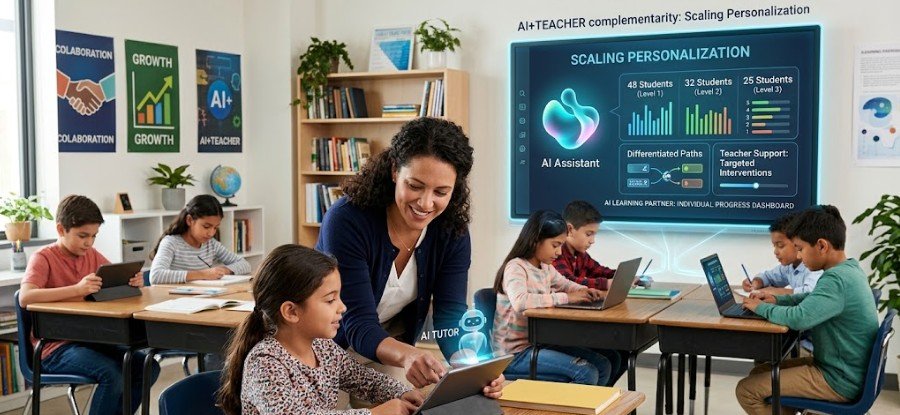
One of the greatest challenges of personalised learning is scaling. A teacher may have dozens of students in the classroom, each with different levels of prior knowledge, learning pace, misconceptions, and needs. Monitoring every learner in this situation becomes increasingly difficult, even for highly experienced educators.
AI tools can be deployed to help address this challenge by continuously processing information that would be impractical for a teacher to examine manually; in this way, the AI tool is adapting the learning process to individuals’ learning pace and needs.
For instance, imagine this scenario:
Student A needs more practice with foundational concepts, while Student B has mastered the same material and is ready for extension work. Instead of requiring the teacher to manually analyse every interaction, the system can surface these patterns, and the teacher can then reflect on what kind of affective support will be most effective.
Therefore, the production chain can then be described as follows:
AI handles educational data processing at scale and pattern recognition; the teacher applies context and pedagogical judgment; the student receives more targeted support. By following this cycle, maintaining meaningful human oversight becomes the central principle of teacher-AI complementarity.
Challenging AI Recommendations
An AI recommendation should be treated as a starting point for professional inquiry, rather than an unquestionable decision. Teachers should be courageous and be able to ask the following to assess AI recommendations:
- What evidence produced this recommendation?
- Does it correspond with what I have observed in class?
- Could there be another explanation for the student’s behaviour?
- Is this intervention appropriate for this particular learner?
- How will I know whether the recommendation worked?
The ability of the teacher to carefully review AI recommendations and question them against known student characteristics, as outlined above, is necessary because learning data can sometimes be incomplete or misleading.
Practical Classroom Example
Consider a secondary-school science teacher responsible for a large class.
An adaptive learning system analyzes students’ response to formative activities and identifies several students who appear to have difficulty distinguishing between related scientific concepts. It recommends additional explanatory material and practice questions.
The teacher reviews the information and notices that some of the students have actually demonstrated understanding during classroom discussions. Rather than assigning the recommended material to everyone, the teacher decides to use a short diagnostic activity to confirm the nature of the difficulty.
The teacher then groups students according to their needs: some receive a brief review of the underlying concept, others complete additional application exercises, and students who have already mastered the material move to an extension task.
Here, AI has made personalisation more manageable, but the teacher has determined how personalisation should occur.
Benefits of the hybrid model
Teacher-AI complementarity can otherwise be referred to as a hybrid model. When this model is thoughtfully implemented, teacher-AI collaboration can offer several advantages, such as:
- Greater visibility: AI can help teachers identify patterns that are difficult to detect through classroom observation alone.
- More timely intervention: Teachers can receive a timely warning about emerging difficulties a student might be facing before a major assessment.
- Reduced administrative burden: Routine analysis and recommendation tasks can be partially automated, allowing teachers to devote more time to instruction and interaction.
- More differentiated learning: Students can receive activities that better reflect their current level of understanding.
Conclusion
To successfully integrate AI tools into educational processes, professional development is consequently important. Teachers therefore need to remain actively involved in designing and evaluating how AI is used. They should understand what the system can and cannot infer, what data it uses, and how its recommendations can be analyzed to understand how they relate to the curriculum objectives.
Share this: