

Understanding Learner Readiness
Knowing when a learner is ready to move forward
Introduction
Learning is a process, and progress can be asymmetric; a student may improve rapidly in quantitative subjects while making slow progress in qualitative subjects. So, in a group of students, some can catch up on time while some might need extra attention and support. Managing learning progress, which includes knowing when a learner is intellectually ready to proceed to the next step/stage in their learning process, requires a deep understanding of an individual learner’s ability, including pace and preference.
Readiness Timestamp
Progressing to greater complexity before a student grasps foundational principles is one of the quickest ways to derail learning- this practice happens most often, especially in the traditional, one-size-fits-all learning environment. In this space, curriculum is standardised and a fixed subject timetable is drawn, e.g. teaching-learning duration of 45 mins or 60 mins to teach a prerequisite topic before moving to a more complex one without considering or assessing the state of individual’s learner understanding of the topic. This kind of environment does not recognise the reality of learner variability. Here is a fact: a class consists of 20 students; it is almost certain that such a classroom includes 20 different learning abilities, including learning style and pace. This makes their readiness timestamp different from the other
Adaptive scheduling and pacing strategies address these challenges by replacing fixed calendars with dynamic, data-driven decisions—ensuring learners advance only when they have acquired substantial understanding of the prerequisite topic and are equipped to succeed in the next topic.
Key Pillars of Learner Readiness
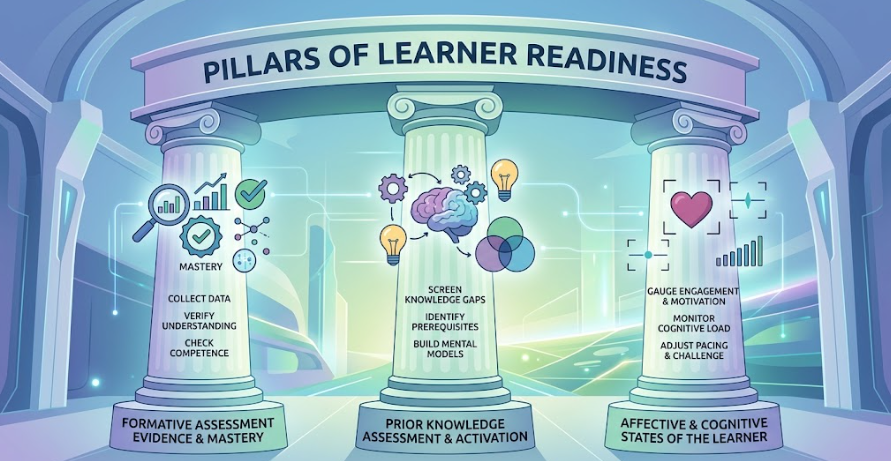
There are essential factors that prepare a learner to learn effectively. These factors are considered the key pillars of learner readiness.
Formative Assessment Evidence & Mastery: Progression must be anchored in a sequentially demonstrated competence, not elapsed time. Continuous formative checks provide the evidence needed to verify that core skills are securely mastered before introducing new material.
Prior Knowledge Assessment & Activation: Complex learning builds on existing mental frameworks. Diagnostic screening ensures students possess the prerequisite concepts necessary to synthesise higher-level topics.
Affective & Cognitive States of the Learner: Readiness extends beyond academic scores to encompass real-time engagement, motivation, and mental bandwidth. Acknowledging the indicators of these states can enable educators to identify cognitive overload or fatigue and adjust pacing strategies.
Core Strategies for Adaptive Pacing
Micro-Assessment Loops: This is a frequent but low-stakes check that can be integrated directly into the learning tasks. This approach can provide immediate feedback without generating text anxiety.
Differentiated Progression Pathways: This strategy involves the creation of sequential branching content based on the learner’s real-time performance data. The pedagogical impact of this strategy includes offering targeted remediation for struggling students and accelerating advanced learners.
Flexible Time Horizon: This strategy involves scheduling the duration for the delivery of learning content based on the complexity of the topic. In other words, for this strategy, we don’t need to follow a fixed timeline; instead, the amount of time allocated to each topic will largely depend on the complexity level of that topic. This allows deep mastery over superficial completion.
Designing an Environment that is Responsive to Learner Readiness
Building a learning environment responsive to learner readiness requires a shift from rigid curricula to fluid, flexible instructional design practice- a data-driven design practice. Learning platforms should be designed to track multiple indicators simultaneously—balancing quantitative test scores with qualitative signals like student confidence and self-efficacy.
By aligning instructional timing with genuine readiness, educators can minimise gaps in understanding, reduce burnout, and foster long-term skill retention.
Share this: